- Laws
- Guernsey & Bailiwick
- P
- Pensions
- Secondary Pensions (Guernsey and Alderney) Law, 2022
Secondary Pensions (Guernsey and Alderney) Law, 2022
View printable versionTo access the legislation in printable format, please click the "view printable version" button.
PROJET DE LOI
ENTITLED
The Secondary Pensions
(Guernsey and Alderney) Law, 2022
ARRANGEMENT OF SECTIONS
PART I
SCHEDULE : Approbated Pension Schemes
PROJET DE LOI
ENTITLED
The Secondary Pensions
(Guernsey and Alderney) Law, 2022
THE STATES, in pursuance of their Resolutions of 5th February, 2020[a] and 23rd November, 2022[b], have approved the following provisions which, subject to the Sanction of His Most Excellent Majesty in Council, shall have force of law in the Islands of Guernsey, Herm, Jethou and Alderney.
PART I
APPROBATED PENSION SCHEMES
Synopsis of provisions.
1. This Law -
(a) requires employers to enrol designated employees into certain pension schemes, referred to as approbated pension schemes, and
(b) makes provision for a compliance and enforcement regime and other general matters (see Parts II and III).
Duty for employers to enrol employees into a pension scheme.
2. (1) Where a designated employee is not an active member of an approbated pension scheme provided by that employee's employer, the employer must, subject to section 6(2), immediately enrol the employee into an approbated pension scheme (see the Schedule) in accordance with regulations of the Committee under subsection (2), and the employer may deduct the employee contributions from the employee's salary accordingly and shall also make the employer contributions.
(2) The Committee may by regulations -
(a) prescribe the date(s) on which the duty in subsection (1) takes effect ("the operative date"), in what manner and in relation to which persons,
(b) provide that, if employers do not use the Trust created under section 25 as an approbated pension scheme, employers must give employees a choice of being enrolled into the employer's chosen approbated pension scheme or the Trust, make provision for the form and manner in which such choice must be provided, and determine in what scheme the employee must be enrolled where no choice is made and the other consequences thereof.
(3) For the purposes of this Law -
(a) an "active member" of a pension scheme is a member accruing benefits under the scheme as a direct result of that member’s employment,
(b) an "approbated pension scheme" is a pension scheme that meets the requirements of the Schedule, the provisions of which have effect accordingly,
(c) "contract of employment" means a contract of service or apprenticeship, whether express or implied and whether written or oral,
(d) a "designated employee" is an employee who –
(i) is 16 years old or over,
(ii) is not of pensionable age or over (as defined in section 121 of the Social Insurance Law),
(iii) is not in full time education,
(iv) is resident in Guernsey, Herm, Jethou or Alderney,
(v) is likely to earn per annum in excess of the lower earnings limit specified for the purpose of section 20 of the Social Insurance Law,
(e) an "employee" is an individual who has entered into or who works under a contract of employment,
and the Committee may amend this subsection by regulations.
Provision of information.
3. (1) Where an employee is enrolled into an approbated pension scheme pursuant to section 2(1), the employer must ensure that the employee is provided with information about it, including, in particular -
(a) a summary of the key features, benefits and provisions of the scheme,
(b) an explanation of the employee's rights and responsibilities thereunder,
(c) an explanation of the rights and responsibilities of the employer, administrator and any other persons thereunder, as relevant to the employee,
(d) where rights to benefits thereunder are subject to vesting rules, the requirements of these rules and the consequent entitlements,
(e) details of all charges or anticipated charges, which are or may be borne by the employee directly or indirectly including -
(i) the amount of the charge if possible to quantify,
(ii) what the charge is for,
(iii) to whom the charge is payable,
(iv) the basis of the calculation of the charge, and
(v) details of any deductions, commissions, or other inducements or incentives, that may be received by the employer, administrator, or any other party insofar as the administrator is aware, either directly or indirectly, in relation to any services provided to the scheme,
(f) save where not permitted by the relevant contract of employment -
(i) the right to opt out (see section 4), details of how that right can be exercised, and the consequent right to a refund of contributions, and
(ii) details of any other right to withdraw from the scheme and the procedure to be followed,
(g) details of the administrator's procedure for resolving complaints including contact details for any relevant ombudsman.
(2) Where it is not practical to provide the information in subparagraph (l)(e), the employer must ensure that the employee is provided with a description of what the charges, deductions, commissions or other inducements or incentives are and the reasons why it is not practical to provide further information.
(3) Notwithstanding the provisions of the Data Protection (Bailiwick of Guernsey) Law, 2017, the employer may share a designated employee's personal data with the administrator without the employee's consent for the purpose of complying with the requirements of section 2.
(4) For the purpose of this Law "administrator" means the person primarily responsible for the management and administration of the approbated pension scheme.
Opt out.
4. (1) Save where the contract of employment does not permit, upon enrolment into an approbated pension scheme the employee may decide to terminate the employee's membership of the scheme ("opt out"), which decision must be exercised in writing in such form and manner as the employer may reasonably require.
(2) Where the right to opt out is exercised within 6 weeks from the date of enrolment, both the employer and the employee must be given a full refund of their respective contributions from the administrator within a reasonable time,
(3) After the right to opt out is exercised, the employer -
(a) shall ensure that the written decision to opt out is retained for at least 7 years, and
(b) must re-enrol the employee into an approbated pension scheme within 3 months of the third anniversary of the decision to opt out.
(4) For the avoidance of doubt, references to enrolment in subsections (1) and (2) include re-enrolment.
Right to opt in.
5. (1) Where an employee is under 75 years old and is either -
(a) not a designated employee by virtue of –
(i) being of pensionable age or over,
(ii) earning less than the lower earnings limit, or
(iii) being in full time education, or
(b) a designated employee and has opted out in accordance with section 4,
the employee may request that the employer enroll the employee into an approbated pension scheme ("opt in").
(2) Subject to section 6, where an employer receives a request from an employee to opt in in accordance with subsection (1), the employer must enroll the employee within the later of 1 month from the date of the request, or 3 months from the date on which the employee previously decided to opt out.
(3) Where a designated employee has been enrolled into an approbated pension scheme under this section, notwithstanding paragraph 1(4) of the Schedule, only where such enrolment is in accordance with subsection (1)(b) need the employer make contributions to that employee's pension.
Deferred enrolment.
6. (1) Where an employer is required to enrol an employee into an approbated pension scheme pursuant to section 2 or 5, the employer may, notwithstanding the provisions of those sections, defer the enrolment provided that the employer gives notice in writing in advance of the deferral to the employee, which notice must provide the date on which the employee will be enrolled in the scheme.
(2) The date of deferred enrolment under subsection (1) must be no later than 3 months from the date on which the enrolment ought otherwise to have been done.
PART II
COMPLIANCE AND ENFORCEMENT
Statements of Practice.
7. (1) The Director may issue statements of practice for the purpose of providing practical guidance in respect of any provision made by or under this Law and in connection with the administration of this Law.
(2) Statements of practice shall come into force on such date as the Director may appoint and shall be published, together with any revision thereof, in such manner as the Director considers appropriate.
(3) The Director may revoke or vary any statement of practice, and a statement of practice may contain such consequential, incidental, supplementary and transitional provision as may appear to be necessary or expedient.
(4) Statements of practice must be taken into account by the Director in exercising the Director’s functions under this Law.
(5) In any proceedings a relevant provision of a statement of practice may be adduced in evidence and where appropriate relied on as tending to support or, as the case may be, defeat a decision of the Director.
Duty to make returns.
8. (1) Every employer must provide the Director with such information and documents as the Director may require to show whether the duty in section 2 or section 5 applies and if so, to demonstrate that that duty is being and has been met.
(2) The information and documents to be provided under subsection (1) must be provided in such form and manner, at such times or intervals and within such period as the Director may require.
Penalties for failure to make a return.
9. An employer who fails to submit a return as required by section 8 to the Director on the date on which the return is due shall be liable to a penalty not exceeding £300 and the employer shall in addition be liable to a further penalty not exceeding £50 for every day after the imposition of the original penalty during which the failure continues.
Information notices.
10. (1) The Director may, by notice in writing issued to any employer, employee or administrator, require that person to provide to the Director, in such form and manner, at such times or intervals and within such period as may be specified in the notice, information and documents of such descriptions as may be so specified, being -
(a) information demonstrating compliance with this Law, and/or
(b) information of a kind which the Director considers necessary for the purpose of reviewing compliance with the Law.
(2) Provision may be made by regulations of the Committee requiring a person of any description specified in subsection (1) to furnish the Committee, in such form and manner, at such times or intervals and within such period as may be prescribed, information of such descriptions as may be prescribed relating to compliance with this Law and which the Committee considers that it requires for the purpose of evaluating the functioning of the Law and in order to facilitate the performance of the Director's or Committee's functions under this Law.
Compliance notices.
11. (1) The Director may issue a compliance notice to an employer if the Director is of the opinion that the employer has contravened a provision of this Law.
(2) A compliance notice is a notice directing the person to whom it is issued to take, or refrain from taking, the steps specified in the notice in order to remedy the contravention.
(3) A compliance notice may, in particular -
(a) state the period within which any step must be taken or must cease to be taken,
(b) require the person to whom it is issued to provide within a specified period specified information relating to the contravention,
(c) require the person to inform the Director, within a specified period, how the person has complied or is complying with the notice,
(d) state that, if the person fails to comply with the requirements of the notice, the Director may issue a fixed penalty notice under section 16.
(4) The steps specified in the notice may, in particular, include such steps as the Director thinks appropriate for placing any employee to whom the contravention relates in the same position (as nearly as possible) as if the contravention had not occurred.
(5) A compliance notice may give the person to whom it is issued a choice between different ways of remedying or preventing the recurrence of that person's contravention.
Third party compliance notices.
12. (1) The Director may issue a third party compliance notice if the Director is of the opinion that -
(a) a person has contravened a provision of this Law, and
(b) the contravention is or was, wholly or partly, a result of a failure of another person (the "third party") to do any thing or a default by the third party in the doing of any thing.
(2) A third party compliance notice is a notice directing the third party to take, or refrain from taking, the steps specified in the notice in order to remedy or prevent a recurrence of the failure or default.
(3) A third party compliance notice may, in particular -
(a) state the period within which any step must be taken or must cease to be taken,
(b) require the person to whom it is issued to provide within a specified period specified information relating to the contravention,
(c) require the third party to inform the Director, within a specified period, how the third party has complied or is complying with the notice,
(d) state that, if the third party fails to comply with the requirements of the notice, the Director may issue a fixed penalty notice under section 16.
(4) A third party compliance notice may give the third party a choice between different ways of remedying or preventing the recurrence of the third party's failure or default.
Unpaid contributions notices.
13. (1) The Director may issue an unpaid contributions notice to an employer if the Director is of the opinion that relevant contributions as defined in section 15 have not been paid when those contributions fall due.
(2) An unpaid contributions notice is a notice requiring an employer to pay into a pension scheme by a specified date an amount in respect of relevant contributions that have not been paid.
(3) An unpaid contributions notice may, in particular -
(a) specify the scheme to which the contributions are due,
(b) specify the amount of contributions that are due,
(c) specify the employees, or category of employees, in respect of whom the contributions are due,
(d) state the period in respect of which the contributions are due,
(e) state the date on which those contributions fell due,
(f) require the employer to take such other steps in relation to remedying the failure to pay the contributions as the Director considers appropriate,
(g) state that, if the employer fails to comply with the requirements of the notice, the Director may issue a fixed penalty notice under section 16.
Calculation and payment of contributions.
14. A compliance notice under section 11 and an unpaid contributions notice under section 13 may, in particular, include—
(a) a requirement to calculate the amount of relevant contributions as may be specified in the notice ("unpaid relevant contributions"),
(b) a requirement to pay interest on the amount required by the notice to be paid in respect of unpaid relevant contributions, at a rate and in respect of a period determined by the Director.
Meaning of "relevant contributions".
15. In sections 13 and 14 "relevant contributions" are the contributions payable to an approbated pension scheme in relation to the employee which are payable by the employer -
(a) on the employer's own account (but in respect of the employee), and/ or
(b) on behalf of the employee out of deductions from the employee's earnings.
Fixed penalty notices.
16. (1) The Director may issue a fixed penalty notice to a person if the Director is of the opinion that the person has failed to comply with -
(a) an information notice under section 10,
(b) a compliance notice under section 11,
(c) a third party compliance notice under section 12,
(d) an unpaid contributions notice under section 13, or
(e) any other provision of this Law (save for a failure to complete a return under section 8).
(2) A fixed penalty notice is a notice requiring the person to whom it is issued to pay a penalty within the period specified in the notice.
(3) The penalty -
(a) is to be determined in accordance with regulations of the Committee made under this paragraph, and
(b) must not exceed £50,000.
(4) A fixed penalty notice must -
(a) state the amount of the penalty,
(b) state the date, which must be at least 4 weeks after the date on which the notice is issued, by which the penalty must be paid,
(c) state the period to which the penalty relates,
(d) specify the failure to which the notice relates,
(e) state that, if the failure to comply continues, the Director may issue an escalating penalty notice under section 17,
(f) notify the person to whom the notice is issued of the review process under section 19 and the right of referral to the Revenue Service Tribunal under section 20.
Escalating penalty notices.
17. (1) The Director may issue an escalating penalty notice to a person if the Director is of the opinion that the person has failed to comply with -
(a) an information notice under section 10,
(b) a compliance notice under section 11,
(c) a third party compliance notice under section 12, or
(d) an unpaid contributions notice under section 13.
(2) Notwithstanding subsection (1), the Director may not issue an escalating penalty notice if it relates to failure to comply with a notice and the person to whom that notice was issued -
(a) has applied for a review of it under section 19 and the review has not been completed, or
(b) has exercised the right of referral to the Revenue Service Tribunal under section 20 in respect of a fixed penalty notice issued in relation to that notice, and the reference has not been determined.
(3) An escalating penalty notice is a notice requiring a person to pay an escalating penalty if the person fails to comply with a notice referred to in subsection (1) before a specified date.
(4) An escalating penalty is a penalty which is calculated by reference to a prescribed daily rate.
(5) The prescribed daily rate—
(a) is to be determined in accordance with regulations of the Committee made under this paragraph, and
(b) must not exceed £10,000.
(6) An escalating penalty notice must—
(a) specify the failure to which the notice relates,
(b) state that, if the person fails to comply with the notice referred to in subsection (1) before a specified date, the person will be liable to pay an escalating penalty,
(c) state the daily rate of the escalating penalty and the way in which the penalty is calculated,
(d) state the date from which the escalating penalty will be payable, which must not be earlier than the date specified in the fixed penalty notice under section 16(4)(b),
(e) state that the escalating penalty will continue to be payable at the daily rate until the date on which the person complies with the notice referred to in subsection (1) or such earlier date as the Director may determine,
(f) notify the person of the review process under section 19 and the right of referral to the Revenue Service Tribunal under section 20.
Penalty notices: recovery.
18. Any penalty payable under section 9, section 16 or section 17 is recoverable by the Director as a civil debt from the person to whom the notice was issued.
Review of notices.
19. (1) The Director may review a penalty or notice to which this section applies -
(a) on the written application of the person on whom the penalty was imposed or to whom the notice was issued, or
(b) if the Director otherwise considers it appropriate.
(2) This section applies to -
(a) a penalty imposed under section 9,
(b) the following notices –
(i) an information notice under section 10,
(ii) a compliance notice under section 11,
(iii) a third party compliance notice under section 12,
(iv) an unpaid contributions notice under section 13,
(v) a fixed penalty notice under section 16, and
(vi) an escalating penalty notice under section 17.
(3) Regulations of the Committee made under this subsection may prescribe the period within which -
(a) an application to review a penalty or notice may be made under subsection (1)(a),
(b) a penalty or notice may be reviewed under subsection (1)(b).
(4) On a review of a penalty or notice, the effect of the penalty or notice may be suspended at the discretion of the Director for the period beginning when the Director determines to carry out the review and ending when the review is completed.
(5) In carrying out a review, the Director must consider any representations made by the person on whom the penalty was imposed or to whom the notice was issued, as the case may be.
(6) The Director's powers on a review include power to—
(a) confirm, vary or revoke the penalty or notice,
(b) substitute a different penalty or notice.
References to the Revenue Service Tribunal.
20. (1) A person on whom a penalty is imposed under section 9 or to whom a notice is issued under section 16 or 17 may, if one of the conditions in subsection (2) is satisfied, make a reference to Revenue Service Tribunal in respect of -
(a) in the case of a penalty, the imposition of the penalty or the amount of the penalty,
(b) in the case of a notice, the issue of the notice or the amount of the penalty payable under the notice.
(2) The conditions are —
(a) that the Director has completed a review of the penalty or notice, as the case may be, under section 19,
(b) that the person on whom the penalty was imposed or to whom the notice was issued has made an application for the review of the penalty or notice under section 19(1)(a) and the Director has determined not to carry out such a review.
(3) On a reference to the Revenue Service Tribunal in respect of a notice, the effect of the notice is suspended for the period beginning when the Revenue Service Tribunal receives notice of the reference and ending—
(a) when the reference is withdrawn or completed, or
(b) if the reference is made out of time, on the Revenue Service Tribunal determining not to allow the reference to proceed.
(4) For the purposes of subsection (3), a reference is completed when—
(a) the reference has been determined,
(b) the Revenue Service Tribunal has remitted the matter to the Director, and
(c) any directions of the Revenue Service Tribunal for giving effect to its determination have been complied with.
(5) The Committee may, by regulations, make further provision for appeals from decisions under this Law, including, without limitation, appeals from decisions of the Revenue Service Tribunal.
Offence of failing to comply.
21. An offence is committed by an employer who without lawful authority or reasonable excuse contravenes any duty imposed under section 2 or 5 of this Law, or notice issued under this Law.
Offences by legal persons, etc.
22. (1) Where an offence under this Law is committed by a legal person and is proved to have been committed with the consent or connivance of, or to be attributable to any neglect on the part of any of the following persons -
(a) any director, manager, secretary or other similar officer, or any general partner or foundation official, of the legal person, or
(b) any person purporting to act in any such capacity,
that person as well as the legal person is guilty of the offence and may be proceeded against and punished accordingly.
(2) Where the affairs of a legal person are managed by its members, subsection (1) applies to a member in connection with that member's functions of management as if that member were a director.
(3) Where an offence under this Law is committed by an unincorporated body and is proved to have been committed with the consent or connivance of, or to be attributable to any neglect on the part of, any of the following persons –
(a) in the case of any type of partnership, any partner,
(b) in the case of any other unincorporated body, any officer of that body who is bound to fulfil any duty whereof the offence is a breach or, if there is no such officer, any member of the committee or other similar governing body, or
(c) any person purporting to act in any capacity described in paragraph (a) or (b),
that person as well as the unincorporated body is guilty of the offence and may be proceeded against and punished accordingly.
(4) Where an offence under this Law is alleged to have been committed by an unincorporated body, proceedings for the offence shall, without prejudice to subsection (1), be brought in the name of that body and not in the name of any of its members.
(5) A fine imposed on an unincorporated body on its conviction of an offence under this Law shall be paid from the funds of that body.
False or misleading information.
23. (1) A person who -
(a) in or in connection with furnishing any statement, information or document to the Director or the Committee under the provisions of this Law,
(b) in purported compliance with a requirement imposed by or under the provisions of this Law, or
(c) otherwise than as mentioned in paragraph (a) or (b) but in circumstances in which that person intends, or could reasonably be expected to know, that the statement, information or document provided would or might be used by the Director or Committee for the purpose of exercising the functions conferred by or under this Law -
(i) makes a statement which that person knows or has reasonable cause to believe to be false, deceptive or misleading in a material particular,
(ii) dishonestly or otherwise, recklessly makes a statement which is false, deceptive or misleading in a material particular,
(iii) produces or furnishes or causes or permits to be produced or furnished any information or document which that person knows or has reasonable cause to believe to be false, deceptive or misleading in a material particular, or
(iv) dishonestly or otherwise, recklessly produces or furnishes or recklessly causes or permits to be produced or furnished any information or document which is false, deceptive or misleading in a material particular,
is guilty of an offence.
(2) An employer who fails to provide the Director or Committee with any information in that employer's possession knowing or having reasonable cause to believe -
(a) that the information is relevant to the exercise by the Director or Committee of their functions under this Law, and
(b) that the withholding of the information is likely to result in the Director or Committee being misled as to any matter which is relevant to and of material significance to the exercise of those functions in relation to the employer,
is guilty of an offence.
Penalties.
24. A person guilty of an offence under section 21 or 23 is liable –
(a) on summary conviction, to imprisonment for a term not exceeding 6 months, to a fine not exceeding twice level 5 on the uniform scale, or to both,
(b) on conviction on indictment, to imprisonment for a term not exceeding 2 years, to a fine, or to both.
PART III
GENERAL
Duty for the Committee to establish a pension trust.
25. The Committee must create a pension trust to facilitate the provision of pensions for residents of the islands of Guernsey, Herm, Jethou and Alderney, which must ensure that all employers are able to meet the obligations arising under this Law and that members are able to accrue and access benefits arising thereunder, this trust to be called the Guernsey and Alderney Pension Trust ("the Trust"), and it may, from time to time, be referred to by whatever name the Committee so directs.
General provisions as to subordinate legislation.
26. (1) The States may by Ordinance –
(a) amend Part II of this Law,
(b) make such other provision as they think fit for the purposes of carrying this Law into effect, and
(c) make such amendments to any other enactment as they think fit where it is necessary or expedient to do so for the purpose of giving proper effect to that enactment and as are consequential upon the enactment of this Law.
(2) Regulations under this Law shall be laid before a meeting of the States as soon as possible after being made; and, if at that or the next meeting the States resolve that the regulations be annulled, then they shall cease to have effect, but without prejudice to anything done under them or to the making of new regulations.
Procedure for Ordinances under this Law.
27. (1) The Committee shall, before recommending the States to agree to make an Ordinance under this Law, consult the Policy and Finance Committee of the States of Alderney in relation to the terms of the proposed Ordinance; but a failure to comply with this section shall not invalidate any Ordinance made under this Law.
(2) An Ordinance made under this Law ceases to have effect in Alderney if, within the period of four months immediately following the approval date, the States of Alderney resolve to disapprove its application to Alderney.
(3) If the States of Alderney resolve to disapprove the application of an Ordinance in accordance with the provisions of subsection (2), the Ordinance ceases to have effect in Alderney, but without prejudice to –
(a) anything done under the Ordinance in Alderney, or
(b) the making of a new Ordinance having effect in Alderney.
(4) In this section "approval date", in relation to an Ordinance, means the date of its approval by the States of Deliberation.
Amendment of the Income Tax Law.
28. After section 150 of the Income Tax Law insert the following section:
"Deemed approval of the Guernsey and Alderney Pension Trust.
150A. The Guernsey and Alderney Pension Trust established pursuant to section 25 of the Secondary Pensions (Guernsey and Alderney) Law, 2022 shall be deemed to be a scheme approved by the Director pursuant to section 150(2) and the provisions of this Law shall have effect accordingly.".
Interpretation.
29. (1) In this Law, unless the context otherwise requires -
"active member" has the meaning given in section 2(3)(a),
"approbated pension scheme" has the meaning given in section 2(3)(b),
"the Committee" means the States of Guernsey Committee for Employment and Social Security,
"contract of employment" has the meaning given in section 2(3)(c),
"defined benefits scheme" means a pension scheme where the benefit is defined independently of the contributions payable and benefits are not directly related to the investments of the scheme,
"defined contribution scheme" means a pension scheme that is not a defined benefits scheme,
"designated employee" has the meaning given in section 2(3)(d),
"the Director" means the Director of the Revenue Service under the Income Tax Law and includes any Deputy Director of the Revenue Service,
"documents" includes information stored or recorded in any form (including, without limitation, in electronic form) and -
(a) in relation to information stored or recorded otherwise than in legible form, references to its production, however expressed, include (without limitation) references to the production of a copy of the information in a form -
(i) in which it can be taken away, and
(ii) in which it is visible and legible or from which it can readily be produced in a visible and legible form,
(b) without prejudice to paragraph (a), references to the production of documents, howsoever expressed, include (without limitation) references to the production of a copy thereof in the English language:
provided always that the Committee may by regulation amend the definition of "documents",
"earnings" has the meaning given in subsection (2),
"employee" has the meaning given in section 2(3)(e),
"Income Tax Law" means the Income Tax (Guernsey) Law, 1975[c],
the "operative date" has the meaning given in section 2(2),
"prescribed" means prescribed by regulations of the Committee,
the "provisions of" this Law include the provisions of -
(a) any Ordinance or subordinate legislation, or any code, guidance, principles, policies or instructions, made or issued under this Law, and
(b) any subordinate legislation, or any code, guidance, principles, policies or instructions, made or issued under any such Ordinance or subordinate legislation,
"the Public Servants' Pension Scheme" means the scheme of that name established and maintained under the States of Guernsey, (Public Servants) (New Pensions and other Benefits) Rules, 2016, as from time to time amended, re-enacted (with or without modification), extended or applied,
"retirement annuity scheme" means a retirement annuity trust scheme or a retirement annuity contract scheme that meets the requirements of paragraph 1(3) of the Schedule,
"Social Insurance Law" means the Social Insurance (Guernsey) Law, 1978[d],
"the Trust" has the meaning given in section 25,
"uniform scale" means the uniform scale of fines for the time being in force under the Uniform Scale of Fines (Bailiwick of Guernsey) Law, 1989[e].
(2) For the purposes of this Law –
(a) "earnings" includes any remuneration or profit derived from an employment,
(b) the amount of a person's earnings for any period, or the amount of that person's earnings to be treated as comprised in any payment made to that person or for that person's benefit, shall be calculated or estimated in such a manner and on such basis as may be prescribed by regulations of the Committee, and
(c) regulations made under paragraph (b) above may prescribe that payments of a particular class or description made or falling to be made to or by a person shall, to such extent as may be prescribed, be disregarded or, as the case may be, be deducted from the amount of that person's earnings.
Citation.
30. This Law may be cited as the Secondary Pensions (Guernsey and Alderney) Law, 2022.
Commencement.
31. This Law shall come into force -
(a) in Guernsey, Herm and Jethou, on the day on which it is registered on the records of the Island of Guernsey, and
(b) in Alderney, on such date as may be prescribed by regulations of the Policy and Finance Committee of the States of Alderney, and different days may be prescribed for different provisions or different purposes.
Extent.
32. This Law shall have effect in the Islands of Guernsey, Herm, Jethou and Alderney.
SCHEDULE
Section 2
APPROBATED PENSION SCHEMES
Essential criteria
1. (1) An approbated pension scheme is -
(a) an occupational pension scheme that meets the requirements of subparagraph (2), or
(b) a retirement annuity trust scheme ("RATS") or a retirement annuity contract scheme ("RACS"') ("retirement annuity scheme") that meets the requirements of subparagraph (3).
(2) In order for an occupational pension scheme to be an approbated pension scheme, it must -
(a) be approved, or deemed to be approved, under section 150(2) of the Income Tax Law,
(b) fall under the Pension Scheme and Gratuity Scheme Rules 2021[f] or under an equivalent or similar statutory pensions regulatory regime in the British Islands (save that this does not apply to the Public Servants' Pension Scheme), and
(c) if the scheme -
(i) is not a defined benefit scheme, contributions to it must meet the contribution requirements in subparagraph (4) below, subject to subparagraph (6), or
(ii) is a defined benefit scheme, the employer must have and obtain, on a triennial basis, from an actuary independent from the employer -
(A) certification to confirm that the actuary considers the benefits for the majority of active members are likely to be at least equivalent to those they would receive by paying the minimum contributions (set out in subparagraph (4)) into a defined contribution scheme, taking into account costs, charges and benefits of a typical defined contribution scheme, and
(B) an opinion confirming the scheme funding arrangements are expected to be adequate to meet the cost of the benefits as they fall due.
(3) In order for a retirement annuity scheme to be an approbated pension scheme -
(a) the scheme must -
(i) be approved under section 157A of the Income Tax Law,
(ii) fall under the Pension Scheme and Gratuity Scheme Rules 2021 or under an equivalent or similar statutory pensions regulatory regime in the British Islands, and
(iii) either –
(A) be established, or adopted by an employer on behalf of its employees, or
(B) be established by the employee and the employer has consented to the use of it for the purpose of this Law.
(b) contributions to the scheme must meet the contribution requirements in subparagraph (4) below, subject to subparagraph (6), with the contributions being paid thereto,
(c) save in respect of a scheme created prior to the operative date, a scheme may not permit loans to members save for the purpose of contributing to the purchase, extension or alteration of the member's principal private residence, provided that residence is in Guernsey, Herm, Jethou or Alderney,
(d) where the scheme was created prior to the operative date, if it permits loans to members, such power may not be exercised save for the purpose of contributing to the purchase, extension or alteration of the member's principal private residence, provided that residence is in Guernsey, Herm, Jethou or Alderney.
(4) Where this subparagraph applies, employers must pay contributions into the pension scheme and such contributions must meet, or exceed, the contribution minima and proportions set out in the table below which applies only to an employee's applicable gross earnings in the relevant pay period.
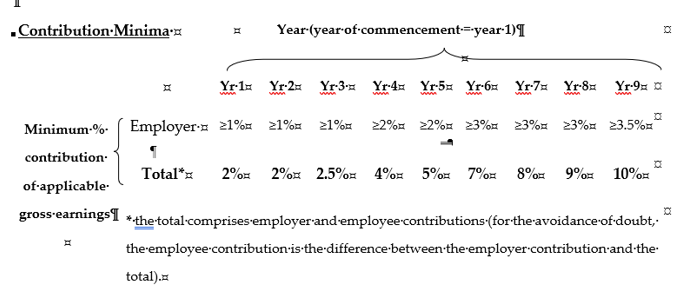
(5) An approbated pension scheme may not require employee contributions in excess of 10% of the employee's applicable gross earnings without the employee's consent.
(6) Subparagraph (4) does not apply -
(a) to any pay period in respect of which an employee earns less than the lower earnings limit, or
(b) to any employer who is not using the scheme as an approbated scheme.
(7) For the purpose of this paragraph -
"applicable gross earnings" means an employee's gross earnings below the upper earnings limit, in the relevant calendar year, and
"pay period" means the period in respect of which the employee is paid.
(8) Where -
(a) a scheme is established in Jersey, and
(b) the employer participates in that scheme prior to commencement of this Law,
subparagraphs (2)(b) and (3)(a)(ii) do not apply.
Amendment of Schedule.
2. This Schedule may be amended by regulations of the Committee.
| [a] |
Article II of Billet d'État No. IV of 2020. |
| [b] |
Article II of Billet d'État No. XX of 2022. |
| [c] |
Ordres en Conseil Vol. XXV, p. 124; this enactment has been amended. |
| [d] |
Ordres en Conseil Vol. XXVI, p. 292; this enactment has been amended. |
| [e] |
Ordres en Conseil Vol. XXXI, p. 278; this enactment has been amended. |
| [f] |
G.S.I. No 142 of 2021. |